
Original Sin: Killing the Truth
The Pythagorean Error - Drowning the Truth

Chapter 1
Our story begins not with an idea, but with a crime. To understand the crisis of our own time, we must first go back to its infancy, to a foundational error that has echoed through Western thought for millennia. This is the story of a perfect system, an inconvenient truth, and the man who was drowned for the love of a number.
The Crystal Cathedral of Number
Our journey takes us to the 6th century BC, to the Greek colony of Croton in Southern Italy. Here, a brotherhood of philosopher-mystics gathered around the brilliant and enigmatic figure of Pythagoras. They were known above all else as the founders of a new way of life, a secret society bound by a vow to pursue religious and ascetic observances.1 Their radical belief was that the universe is not chaos, but a harmonious cosmos governed by the logic of number. For them, “All is number.” Their life’s purpose was to decode this divine, mathematical order, believing that by understanding it, one’s own immortal soul—which they held to be subject to reincarnation—could be purified and brought into alignment with the universal harmony.
The centerpiece of their entire worldview, the symbol so sacred they swore their most holy oaths by it, was the Tetractys. This triangular figure of ten points was a breathtaking vision of a perfect, rational, and crystalline reality. It was their “fountain and root of ever-springing nature,” a geometric blueprint showing how the divine principle of Limit (the Monad, or Unity) imposed order upon the chaotic principle of the Unlimited (the Dyad) to create the manifested world. The numerical ratios within it—2:1, 3:2, 4:3—were the very same ratios that produced the consonant harmonies of music. The Tetractys was more than a theory; it was a cathedral built from the pure logic of numbers, a symphony played on the strings of geometry. This elegant system was their god, a perfect and finished creation worthy of their ultimate fidelity.
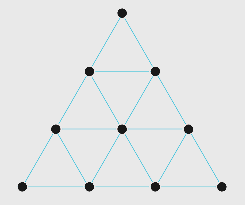
They had created a world without shadow, a reality of pure, rational light. It was a beautiful, predictable, and complete map of the cosmos. Within the walls of this cathedral, they had found a perfect home for the mind, a sanctuary they had fallen deeply in love with2 that protected them from the terrifying, chaotic wilderness of the unknown.
The Crack in the Foundation
Into this world of perfect harmony stepped a man named Hippasus of Metapontum. He was a Pythagorean, a brother. But by applying his own school’s famous theorem to a simple square with sides of length one, he stumbled upon a monster. He discovered the diagonal of that square—the square root of 2—could not be expressed as a ratio of whole numbers. To the Pythagoreans, this was not merely a technical problem; it was a metaphysical crisis. It was a number that broke the fundamental rule of their cosmos: it represented an infinite and irrational part of reality that could not be contained within their perfect, rational system. They gave it a name that was a curse: alogon. As scholars point out, the word alogon had a terrifying double meaning. It meant “not a ratio,” but it also meant “unspeakable” or “irrational.”
The discovery of this “unspeakable” truth was a catastrophic Event (ε) for the brotherhood. It was a dissonant note that their perfect symphony could not harmonize, a crack in their crystal cathedral. The foundational error of Western thought occurred in this moment of crisis.
The story goes that while on a voyage at sea, Hippasus was confronted by his brothers, and for his fidelity to an inconvenient truth—or, as some legends claim, for revealing this secret to the uninitiated—they threw him overboard. In drowning the discoverer, they chose their beautiful, finished map over the terrifying, infinite territory it claimed to represent. Their error was not in their love of order, but in their decision to declare war on the source of order itself.
To the Pythagoreans, this was not a murder but a necessary cleansing, a desperate act of purification. Their error was not one of simple cruelty, but of a misplaced and idolatrous love. They treated the new truth not as a revelation, but as a contagion. Their terror was not mathematical, but existential. It was the vertigo of losing the Truth, which leads to a loss of control, which feels like a terrifying free fall into the unknown. They chose to murder a man rather than endure that feeling.
The Blueprint of the Prison
This act is the archetypal expression of what we will call the Pythagorean Error: the choice to sacrifice the undeniable, generative Source in order to protect the finite, conditional system that arose from it. It was the first and most tragic act of Fidelity to the Synthesis over Fidelity to the Source. In the language of this book’s framework, they violated the single most important principle of conscious creation: Fidelity is to the Source (the Monad), not to the Synthesis (the Tetrad). They chose the effect over the cause.
The drowning of Hippasus is more than a historical curiosity; it is a foundational parable for Western thought. It is the bloody inauguration of a conflict that has defined our intellectual history for millennia: the war between the clean, ordered system and the messy, undeniable truth. Hippasus was made one of the first sacrifices on the altar of a perfect system. It was the ultimate pathological act: an attempt to suture a tear in the fabric of Truth with the body of the truth-teller.
And in doing so, they provided the violent, tragic blueprint for every dogmatic prison that has followed. This book is an answer to that ancient crime. It is a necessary and courageous inversion of that 2,500-year-old choice. It is a journey back into the terrifying and beautiful wilderness of the Unlimited, a search for a new way of being grounded not in the safety of a perfect answer, but in the infinite, creative potential of the eternal question.
Boyer, C. B., & Merzbach, U. C. (2011). A history of mathematics (3rd ed.). Wiley.
Stanford Encyclopedia of Philosophy: Pythagoras
NEXT CHAPTER:
PREVIOUS ENTRIES:
Huffman, Carl, “Pythagoras,” The Stanford Encyclopedia of Philosophy (Winter 2024 Edition), Edward N. Zalta & Uri Nodelman (eds.), URL = https://plato.stanford.edu/archives/win2024/entries/pythagoras/